People often assume B2B marketing is boring. I used to hear this a lot, especially from people who look at marketing only through the lens of big consumer campaigns, celebrity launches, viral videos or fancy brand films. B2B, from the outside, looks too practical. It talks about margins, inventory, returns, fulfilment, stock movement, repeat orders and payment cycles. Not exactly the kind of things people call “exciting.”
But once you spend time inside Indian retail markets, your perspective changes very quickly. B2B marketing is not boring. It is just much closer to reality. The customer here is not buying for entertainment, aspiration or lifestyle alone. A retailer is buying for business. Every product he selects has a direct impact on his working capital, shelf space, customer satisfaction & daily cash flow. That makes marketing in this space more difficult, not less interesting.
At bijnis, while building our B2B Quick Commerce model, we have always believed that marketing cannot only be about visibility. Visibility matters, but it is not enough. In a category where retailers are making real business decisions, marketing has to reduce doubt, create confidence & make the buying journey easier. That thought became even more important for us after we launched our dark store in Agra.
The Dark Store helped us bring supply closer to retailers and made faster fulfilment possible. But one big question remained: how do we make retailers truly experience this new model? How do we show them that bijnis is now closer to their market, that products are more accessible & that they do not have to depend only on a screen or a catalogue to make decisions? In categories like fashion, footwear and lifestyle, touch and feel still matter. A retailer wants to see the product, hold it, check the quality, understand the finish, compare designs & then decide whether it will sell in his market.
That was the starting point of the moving bijnis Sample Van.
The Idea: Take the Sample Room to the Retailer
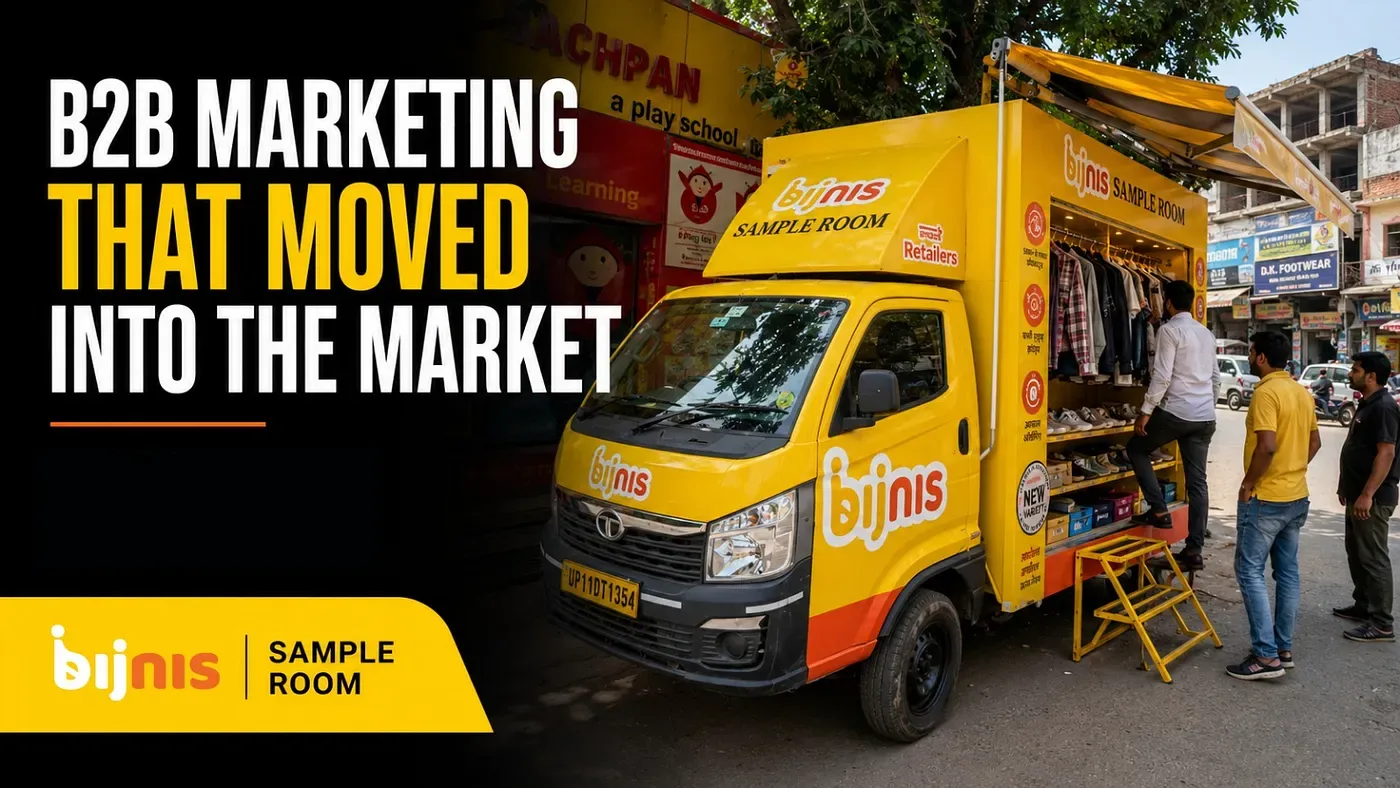
The idea was simple: instead of asking retailers to come to us, we would take the product experience to them. We designed a moving sample room on wheels and took it across different retail markets in Agra for 30 days. The van was not treated like a regular branding vehicle with a logo and a few posters. It was built to work like a compact product experience zone, where retailers could enter, explore samples, speak to the team and understand what bijnis was offering through its local Dark Store model.
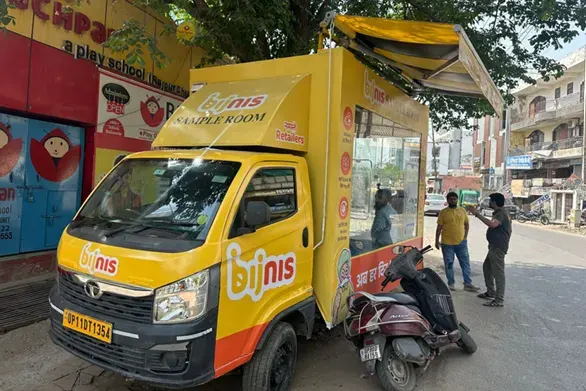
I spent time around the van during this activity because I wanted to see the market reaction first-hand. There is a big difference between reading a campaign report & watching a retailer react in real time. Reports and data tell you the scale of the response, which is important. But being present on ground helps you understand the emotion, hesitation, curiosity and actual customer language behind that response. Both are important, but the market gives you texture that numbers alone cannot fully explain.
The first few reactions were exactly what made this activity so interesting. As the van entered a busy market lane, retailers would step out of their shops and look at it with genuine curiosity. Some would ask, “Ye kya hai?” Others would say, “Andar products hain kya?” A few would smile and ask, “AC bhi hai andar?” That last question became surprisingly important because this was Agra in peak summer. The AC inside the van was not just a comfort feature; it made the experience more inviting. Retailers came in to see what was happening & once they were inside, the real product conversation started.
Why It Worked: Curiosity Became Commerce
The moving Sample Van worked because it did not behave like advertising. It behaved like utility. In a market full of noise, banners, calls, offers and sales pitches, the van created curiosity without forcing itself on the retailer. It made people pause. But more importantly, it gave them a reason to engage.
Once retailers stepped inside, the conversation changed from “What is this van?” to “What products are available?” They picked up samples, checked the material, compared designs, asked about availability, pricing, repeat stock, and delivery timelines. That shift was important. The van was not just creating attention; it was moving retailers closer to business intent.
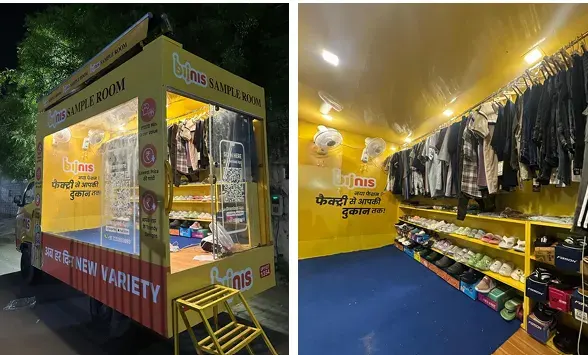
For a retailer, buying stock always carries risk. He is thinking about whether the product will sell, whether his customers will accept the design, whether the pricing will work in his local market, and whether he will get stuck with dead stock. In that context, touch and feel is not a small thing. It is part of his decision-making process. The Sample Van reduced this hesitation by making the product physically accessible inside his own market.
This was also where the connection with the Agra Dark Store became stronger. The retailer could see the product, understand the range and then connect that experience with faster local availability. The Dark Store solved the supply-side problem. The Sample Van helped solve the trust and discovery problem. Together, they made the bijnis proposition much easier to understand.
The Bigger Learning: B2B Marketing Has to Solve Friction
One of the biggest learnings from this activity was that good B2B marketing is not about making the brand look exciting from the outside. It is about solving a real friction point in the customer journey. For retailers, the friction was clear. They wanted to discover products faster, trust the quality before buying, and understand whether bijnis could support their business with quicker availability.
The Sample Van addressed all three. It created awareness by being visible in the market. It created trust by letting retailers experience products physically. It created sharper conversations because the team could respond to retailer questions then and there. It also gave us direct feedback on what retailers noticed first, where they hesitated, what they liked, and what they needed more clarity on.
This is why I believe offline marketing in B2B Quick Commerce is still underrated. Not the old version of offline marketing where brands only put up banners and hope people remember them. I am talking about offline experiences that are built around customer behaviour. The retailer may eventually place an order digitally, but his confidence is often built through what he has seen, touched, discussed & verified.
During the Agra activity, the van became more than a campaign asset. It became a moving feedback and trust-building channel. We could see which products got attention, which questions came repeatedly, how retailers understood the Dark Store model, and what language made the proposition clearer. These are insights you can use not just in marketing, but also in sales, product, supply, and operations.
What the Market Taught Us
The most powerful part of the 30-day journey was seeing how quickly the market reacts when something is both new and useful. If the van had only looked different, people may have stared once and moved on. But because it gave retailers access to real samples and practical business conversations, it stayed relevant beyond the first moment of curiosity.
Retailers are extremely sharp. They may not use corporate terms, but they understand value immediately. If something saves time, reduces risk, improves product confidence, or helps them make better buying decisions, they engage. If something feels like decoration, they ignore it. The Sample Van worked because it respected the retailer’s reality. It did not ask him to leave his market or invest extra time in a formal event. It came to him.
That is an important lesson for anyone building in B2B. Your marketing should not only tell the customer what you offer. It should help the customer experience why it matters. In our case, the retailer did not just hear that bijnis had faster local availability through the Dark Store. He could see the products, understand the range, speak to the team, and connect that experience with the possibility of faster ordering and replenishment.
B2B Marketing Is Not Boring. It Is Just More Accountable.
Looking back, the moving bijnis Sample Van in Agra was one of those experiments that reminded us why this category is so exciting. It had everything a strong B2B marketing activity should have: clear customer problem, strong market visibility, physical product experience, direct feedback, and measurable business impact.
It also reinforced a simple belief for me as a marketer: in B2B, creativity has to be useful. A campaign cannot survive only because it looks good. It has to help the customer move from doubt to confidence. It has to make the business proposition easier to understand. It has to create trust in a way that feels real to the customer.
For 30 days in Agra, the Sample Van did exactly that. It took bijnis into the market, made retailers stop and look, invited them inside, allowed them to experience the product, and helped them understand how our Dark Store model could support their business.
People may still say B2B marketing is boring. But standing there in the market, watching retailers step into a moving sample room and say, “Haan, ab samajh aaya,” it felt anything but boring.
It felt like marketing doing its actual job.
Thanks
Written by Suyash Jain