In B2B fashion, fast delivery only matters when the stock is right. A retailer does not need the wrong product in 60 minutes. He needs the right product, in the right quantity, at the right price, at the exact moment demand is active in his market.
This is the harder supply chain problem bijnis is solving. The visible promise is speed, but the real engine is assortment relevance: knowing what to stock, where to stock it, how much to stock, and when to refill. In fashion wholesale, this is where money is either made or blocked. Wrong stock does not just sit on a shelf; it blocks working capital, reduces retailer confidence, and slows the next buying decision.
Turning Market demand into supply action
India’s B2B fashion market does not run on clean dashboards. It runs on product photos, voice notes, urgent calls, WhatsApp messages, local market instinct, and relationships. A retailer may ask for “the same sports shoe from last week.” Another may share an image and ask for a similar style in a lower price range. A third may need urgent replenishment before the weekend. These are not random conversations. These are live demand signals.
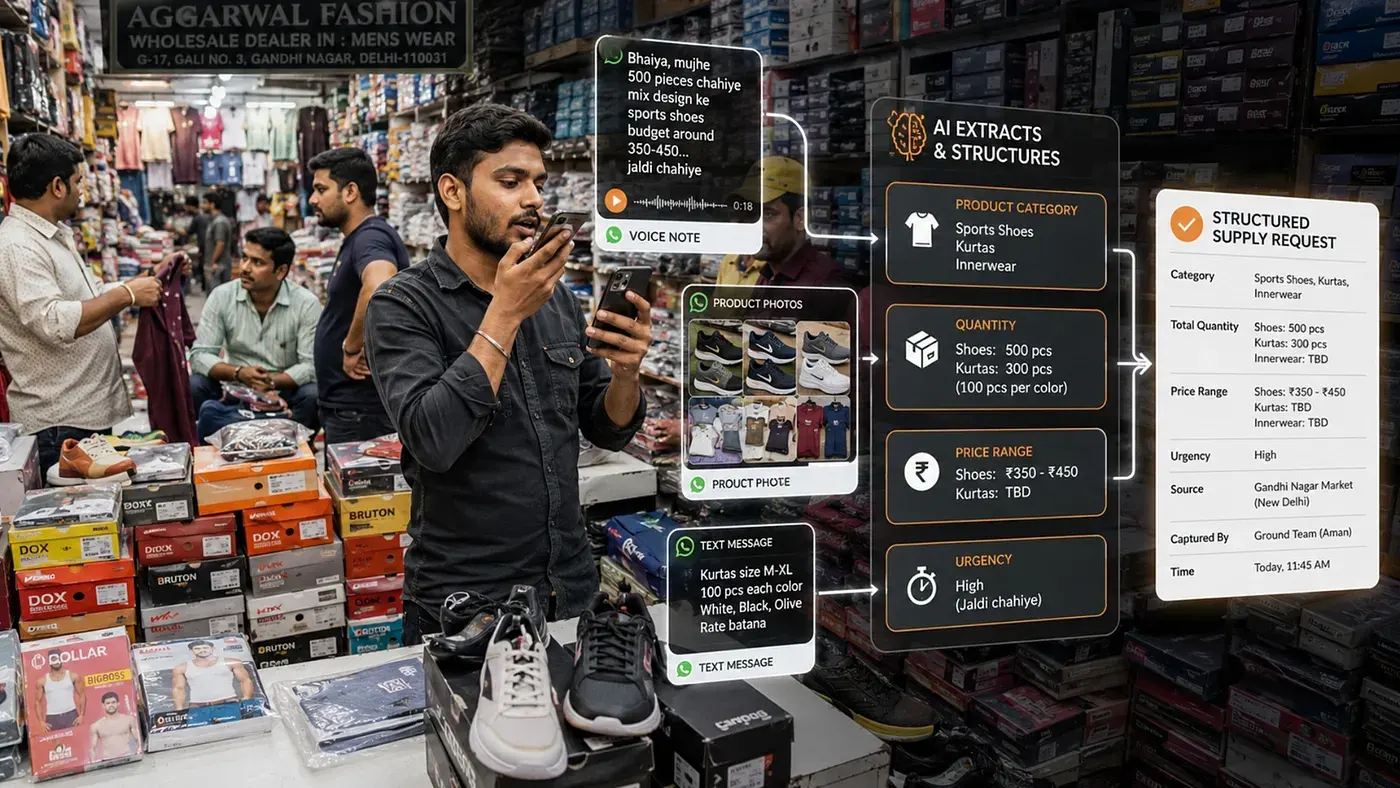
The challenge is that these signals are often messy. A Sales Team Member understands what retailers in a city are asking for. A Supply Team Member understands which products, brands, factories, and price points can fulfil that demand. But between the two, important details can get missed: category, quantity, urgency, price range, colour, brand preference, or whether the request can be fulfilled from the existing catalog.
Earlier, this kind of information could easily get stuck in back-and-forth communication. The Sales Team Member would share a photo, voice note, or requirement. The Supply Team Member would ask for missing details. The retailer would wait. Sometimes the request would move fast. Sometimes it would get buried. In a category like fashion, that delay can mean lost sales, wrong sourcing or dead stock. This is not a communication problem alone. It is a supply chain leakage problem.
This is where bijnis is using AI in a very practical way.
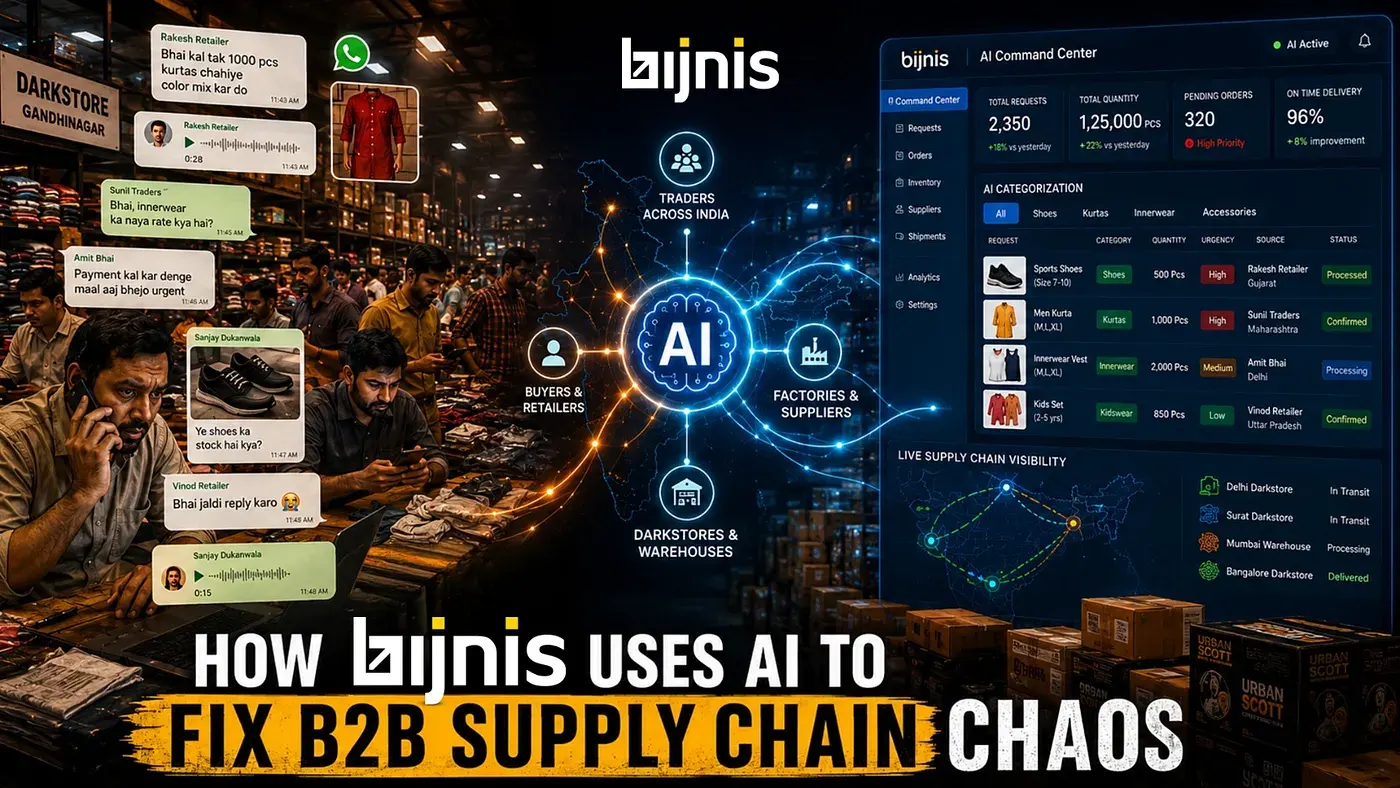
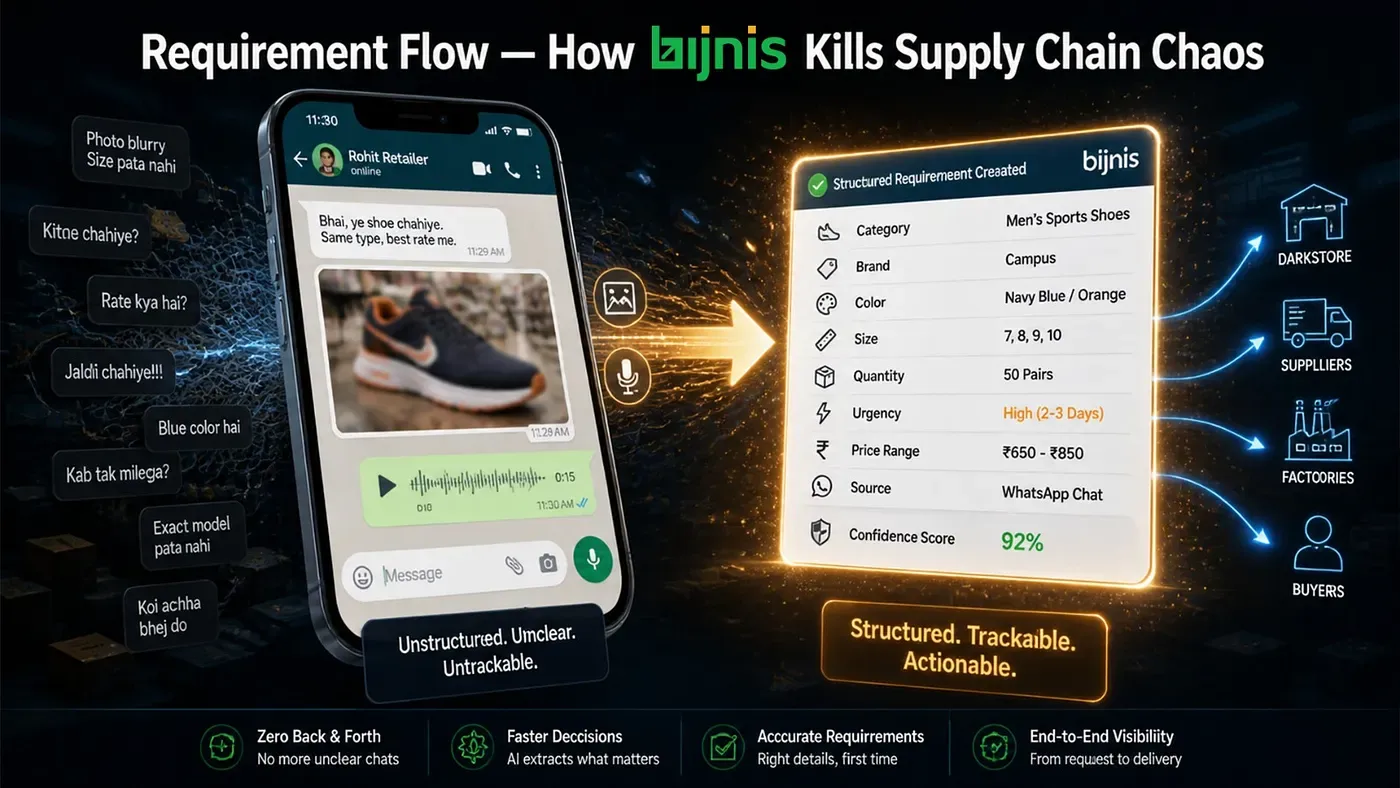
bijnis built Requirement Flow, to convert unstructured market inputs into clear supply requests. Requirement Flow simply means the structured movement of retailer demand from the Sales Team to the Supply Team, without losing context in between.
The system is designed around how people actually work in Indian wholesale. It does not force the Sales Team to fill long forms or change their natural behaviour. A Sales Team Member can upload a product image, record a voice note, or share the requirement in simple language. AI then reads that input and extracts the important details: product category, brand, quantity, urgency, timeline and possible fulfilment route.
If something important is missing, the system can ask for clarification through chat. Once the request is complete, it is classified, checked against the existing catalog, and assigned to the right Supply Team Member for action. The Supply Team Member gets a clear, structured request with all the context they need to make a sourcing decision. They can see the product image, understand the urgency, and know whether it’s a repeat request or a new one. This reduces back-and-forth, speeds up sourcing, and increases the chances of getting the right product to the retailer in time.
This is a small workflow change with a large business impact. A scattered message becomes a trackable requirement. The Supply Team gets cleaner context. The Sales Team gets better visibility. The business can see what is pending, what is processed, what is fulfilled, and where the delay is happening.
Why this matters for B2B Quick Commerce
Most people think 60-minute delivery is a logistics problem. In B2B fashion, it is first an assortment problem. A darkstore is useful only when it holds products retailers in that city actually need. A Sales Team is powerful because it understands live local demand. A Supply Team is effective when it can convert those demand signals into sourcing, catalog, and inventory decisions. AI becomes valuable when it makes this loop faster, cleaner, and measurable.
This is the shift from memory-led supply to signal-led supply.
In traditional wholesale, a lot depends on memory. The retailer remembers what sold. The Sales Team remembers what different retailers asked for. The Supply Team remembers which factory or supplier may have similar products. This works at a small scale, but it does not create strong visibility across cities, categories, labels, price points and repeat requests.
A signal-led system works differently. If many retailers in one city are asking for a similar product, that becomes a demand signal. If a particular label keeps getting repeated requests, that becomes assortment intelligence. If a category needs urgent replenishment again and again, the darkstore can stock it better.
That is the real value of Requirement Flow. It does not replace people, it makes their market understanding more usable. The Sales Team continues to capture real demand from retailers. AI structures that demand. The Supply Team acts on it faster. Darkstores improve local availability. Factories get clearer feedback on what the market actually wants.
The bigger business impact
For retailers, better demand capture means lower risk. They do not want to overbuy or block money in slow-moving stock. They want relevant products, faster replenishment, lower MOQ, and confidence that what they order has a real chance of selling.
For factories, it means clearer market feedback. Instead of producing only on delayed assumptions, they get stronger signals on what retailers are actively asking for. This helps reduce blind production and improves the connection between market demand and factory supply.
For bijnis, this strengthens the core promise of its factory-to-retail network. The goal is not just to deliver faster. The goal is to stock smarter, replenish faster, and reduce the risk of wrong inventory across the chain. That is where AI becomes meaningful in B2B supply chains. Not as a buzzword, not as a replacement for people and not as a shiny layer on top of operations. Its real role is to help the right people act faster on the right signals.
Because in B2B fashion, speed without relevance is noise. The real moat is knowing what to stock, where to stock it, and when to refill.
Thanks
Written by Suyash Jain