We started bijnis with a simple goal - a dream to help the real businesses (bijnis's) of India - its factories and retailers - grow smarter, faster, and bigger.
Most of our early teams had personally grown up witnessing the journeys of factories and retailers. We knew there had to be a better world out there for them in this digital age.
And as I write this, it's been more than a decade of chasing the vision of building a technology-led, direct Factory-to-Retailer supply chain - one that stands 10x better than the traditional, multi-middlemen-led wholesale system.
We have wholeheartedly worked toward this mission - onboarded 2.5 lakh+ retailers, collaborated with 5,000+ factories, built a team that deeply understands wholesale and traditional supply chains, worked frugally and organically, and were fortunate to have some of the most pivotal investors in India backing the dream.
Over the past decade, we've raised $35M+ and peaked at ₹500 Cr+ in annual sales, yet something still felt missing. A few retailers and factories loved us deeply, but for most, we weren't yet the first choice. The traditional wholesale ecosystem remained their primary partner, despite all its inefficiencies.
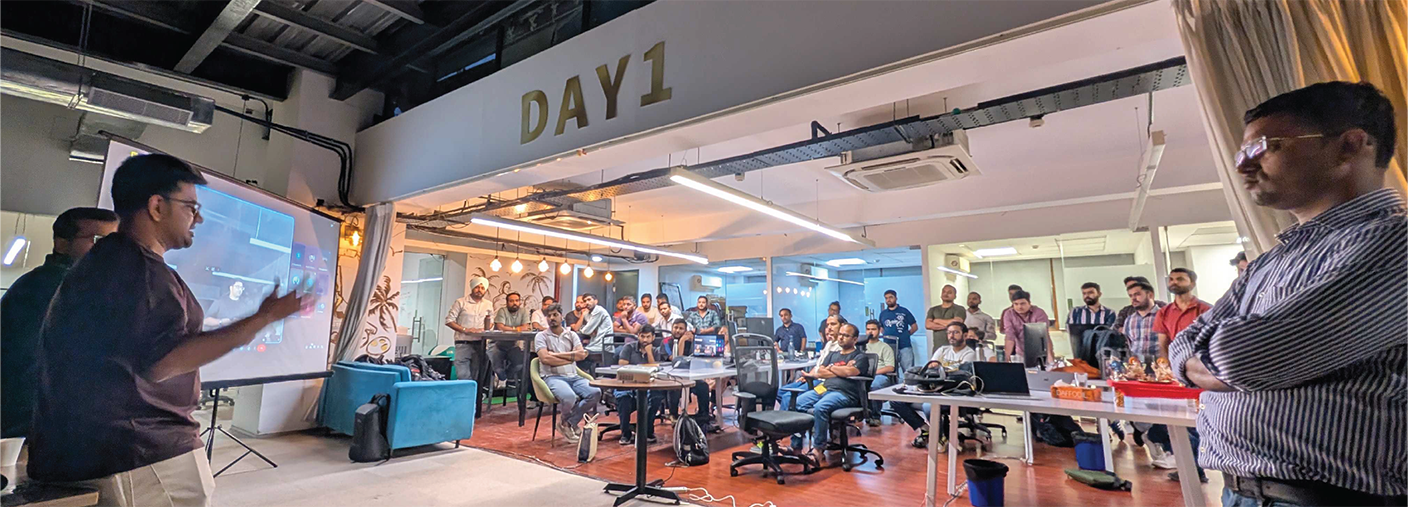
And honestly, over the last five years, we ran countless experiments to tackle this problem, but something wasn't clicking. Around 15 months ago, when one of our major internal experiments couldn't move the needle, we took a hard call: went back to the board, acknowledged that a radical shift was needed in how we approached the problem, and called it 'Day 0' at bijnis again..
The B2B Truth: Repeat is the only God Metric.
Traditionally and until now, India runs on a multi-middlemen-led wholesale supply chain:
- Minimum 2 and maximum 3 between Factory and Retailer
- Each middleman unlocks a specific value - Price Discovery, Relevancy, Warehousing, etc.
Getting these long tail mass retailers to purchase online is not just about price, catalogue quality, or differentiation; it requires a structural behavioural shift amongst them. Only if this shift happens can it lead to a scalable and sustainable B2B platform.
And the only metric that can depict this shift is Month on Month repeat % ,
And, 80% monthly repeat % of unique retailers has been our obsession since day zero. Because in B2B, repeating retailers are the only real value unlock - everything else is a noise.
The Original Marketplace Model & The Fundamental Problems
10 years down the line, when we started, bijnis operated on a simple Marketplace Model - non-inventory, factory-led, with an average 7–8 day delivery cycle. It connected factories directly to retailers without holding stock. We facilitated supply and charged commission from Factories - a pure-play marketplace with tighter control and value check on supply.
Retailers used us for:
- Simple access & discovery – easier product finding and ordering compared to traditional markets
- Better pricing – more transparent and competitive factory-direct rates
- Lower MOQs (Minimum Order Quantities) – ability to buy in smaller lots than traditional traders offered
Factories used us for:
- Access to larger demand
- Alternative medium of capacity utilisation
- 15-day payment cycle versus 120–150 days in offline markets
Not just us - a few other startups and established companies entered the space to capture this large TAM with similar offerings. Everyone scaled GMV categories, but none of the companies, including us, could achieve the 'Organic pull' of retailers - and that is and will be the only way to build a scalable yet sustainable B2B marketplace.
The only difference that stood firm for us was - we will never do credit to crack this organic repeat puzzle; we focused on production principles instead.
Being brought up in wholesale households, we always knew that credit is a drug - it gives a quick high in growth and retention, but only temporarily. Once the cycle ends and payment collections begin, both growth and retention curves collapse.
Given the competition and pressure for growth - we were expected to do the same. However, we stood firm - and I think one of the best decisions we took to reach where we even are - focusing on price, quality, curation over enabling credit for retailers.
We always saw credit as a need coming from inefficiency in the existing supply chain rather than a real need for the retailer's business. Retailers clearly needed something else - or they would keep on buying from traditional local traders
What we expected eventually happened - the credit bubble burst, growth momentum collapsed, some shut down, and a few pivoted into private-label distribution models to survive.
We chose not to use credit to solve the repeat problem. Instead, we experimented with the way we worked with factories - focusing on improving catalogue quality through sharper pricing and better variety.
The experiments worked:
- Cost of production reduced by over 20%
- Take rates improved
- Retailers received even better prices
But, Price wasn't enough for retailers to change their traditional purchasing patterns. We were sitting at industry-best take rates (18%–20%) and offering better prices - but what needed to move – % Repeating Retailers, didn't move.
Honestly, we had nowhere to go. The war chest was depleting, and as much as we wanted to, we couldn't invest a single rupee in growth or acquiring new retailers - because we knew the bucket was leaky; it would all go down the drain. To make it worse, the overall sentiment around B2B was turning bearish.
Yet the instinct about the opportunity was real, genuine, and deep. We couldn't just quit. We had to figure this out - there was no fallback plan. So we ignored the noise, the chaos, and first-principally looked at the real problem statements retailers faced while shifting their behaviour from offline to online.
We had cracked price and margin, but still lacked what a middleman could do - or maybe something else altogether, an absolutely new direction we needed to explore.
A completely different approach.
Real-Time Trading - Why the 60-Minute Factory to Retailer Model Can Work
We suspended all our assumptions, went back to the markets, spent time with retailers and local traders, localized in the retail markets, to understand their exact offering, identified a few clear gaps and patterns - and realized that unless we adopted these, this model wouldn't work.
This was almost 1.5 years back.
During this time, online grocery - the sector which could not crack despite heavy burn - was facing an inflection point as B2C Quick Commerce was proving disruptive. Consumers who had never adopted online grocery before started adopting the quick commerce wave.
We merged learnings from both offline trade and quick commerce and piloted a model with the following offerings:
- 60-minute delivery for Retailers
- Open delivery - retailers could order, touch and feel, and return instantly if they didn't like it
- Highly relevant catalogues - cross-city and cross-retailer
The Pilot and What We Saw
We knew, to enable this, we had to re-look at the business from scratch. However, the first thing was to pilot this. We chose the toughest market - where retailers had excellent access to manufacturing clusters, where we couldn't fetch more than 50 monthly transacting retailers over years of push sales in the 7-day delivery marketplace model.
In the first two months of pilot, we onboarded 1,000+ retailers, with 60%+ MoM retention until 3 months of pilot - and 90% of retailers came from clothing as a category.
The direction became clear. We wanted to move forward. The model had a lot of acceptance but was tough to execute; the inventory risk, especially in fashion/lifestyle, could kill us.
That said, there was no fallback plan - we had to make this work
To create a large B2B platform in Fashion/Lifestyle categories, we had to follow two non-negotiables:
- 80%+ Monthly retailer repeat
- Negative working capital (no wastage in inventory, else money gets stuck)
We needed 95%+ accurate predictability (Sell through) - and historical data held minor relevance. Middlemen were running on intuition.
But gun to the head - we had to solve it.
That's it. We went under the shell, built an all-round tech system within 60 days, and built a model we named 'Real-Time Trading (RTT)'. The model captured historical data and real-time observations from humans on the ground - traders sitting in markets, interacting with retailers daily.
Real-Time Trading offers:
- 60-minute delivery Retailers don't need to stock; they treat us as their go-downs.
- Open delivery - Touch, feel, and accept - or return.
- Real-Time Relevancy Engine - Places real-time bets on fresh production happening across factories, predicting what to stock in Wholesale Dark Stores so retailers see only what sells in their area - not redundant listings.
Real-Time Trading offers: 60-minute delivery, Open Delivery, and Real-Time Relevancy Engine.
Lastly, as we speak about these shifts, bijnis is stepping into a new face, a new energy – And I think it's worth sharing, that's why we chose green for this evolution…
The last 1.5 years have tested us - But building this new model radical demanded a shift not just in operations - but in mindset, culture, and energy. We went into our shell, worked on the ground, rebuilt the offering, took some hard calls, downsized, and slowed down the old model. Rather than closing it, we made it profitable enough to support the new, giving it both cash and backbone until it fully transitions.
And through it all, we made Real-Time Trading - 60-minute delivery for retailers - our reality and our future.
We've been playing on this battlefield for more than a decade. Pivoting to this model after ten years wasn't about just doing it, trying it, or falling for sunk cost fallacy. We asked ourselves a harder question - if we had to spend another decade on the same problem, would we still choose to?
Most of us couldn't step back.
The gap is genuine - and this team at bijnis, after living this problem for a decade, has all the rights to win.
It's not just the new model - we are an Evolved team now, with Evolved DNA, It is time to cut the past threads and evolve into a new energy.
We reimagined the bijnis logo, with an upward 'Growth' sign, and chose Green as the energy we will carry for the years to come.
Why Green?

Green represents prosperity, stability, movement, - rather, businesses should be green. We have some shades of yellow as well - because we think it's not about being slow or fast; it's about movement.
We are building for businesses in India -and when bijnis represents these millions of factories and retailers, and they should be in green always.
bijnis should keep moving. And now, after a decade, it's time to make faster moves, take bigger leaps - no stopping, no looking back.
All green.
💚 The New bijnis Begins.