Assortment Relevancy drives 60 mins delivery in b2b quick commerce.
How bijnis’s Real-Time Trading (RTT) engine makes 60-minute delivery meaningful in B2B quick commerce by solving the harder problem first: what’s on the shelf.
A Tier 2 retailer doesn’t need his stock in 60 minutes. He needs the right stock in 60 minutes. Get the assortment wrong, and 60-minute delivery is just a faster way to get NOTHING. The clock doesn’t save you from a bad assortment decision. It just compresses the timeline on which you discover you made one.
This is why the real problem in B2B quick commerce isn’t logistics. It’s the question every darkstore operator has to answer before the delivery even begins: what should be sitting on the shelf?
At bijnis, we answer that question with a system built specifically for B2B quick commerce, not adapted from retail, not borrowed from planning-led fashion cycles. It is the most important thing we do, and the reason 60-minute delivery is more than a logistics promise.
We Are Not a Planning Company. We Are a Real-Time Trading Company.
Traditional B2B fashion supply chains run on a planning cycle that was never designed for speed. Someone, somewhere, sits down with last season’s data, factors in trend reports, makes a call, places a large order, waits 70–90 days for production, and hopes they guessed right. The entire model is built on the bet that someone can predict what a Tier 2 retailer in Malda or Ludhiana will need, in what quantity, six weeks from now. This works marginally in organized retail where margins are north of 40% and factory-to-store floor takes 90 days of planning.
bijnis doesn’t plan. bijnis trades REAL TIME.
What that means structurally: factories put their live inventory and ongoing production in front of our system. A fresh catalogue goes live for 48 hours across all our traders/curators in all our darkstore cities. Traders place purchase orders. Stock gets allocated to dark stores. And the entire engine is informed before a single piece ships by what has actually sold before, to which Tier 2 retailers, in which cities, at what rate. No forecasting. No guessing. Only live signal.
The assortment isn’t decided. It emerges from a live signal.
How the Signal Works: Four Different Conversations, One System
Not all stock that a factory puts live is the same, and not all buying decisions the system needs to make are the same. This is the part most people outside the business don’t understand — and it’s the core of how RTT (Real Time Trading) functions.
Conversation 1: The Repeat SKU
A white crew-neck cotton t-shirt in Malda has sold 340 units over the past four months. Same label, same fabric weight, same price band. It consistently sells within 10 days of hitting the shelf. When this SKU goes live on the factory feed, the algo doesn’t ask the trader to make a judgment call. It tells the trader what to order based on the historical sell rate, the current stock position at the darkstore, and the replenishment lead time.
The trader’s job here is not to decide whether, it’s to confirm and execute. The system knows more than any individual judgment can, because it has seen this SKU sell across multiple weeks, multiple retailers, multiple reorders. It has a real sell-through rate, a real inventory turn, and a real fill-rate history. The recommendation is a calculation, not an opinion.
This is the most capital-efficient part of the model. Repeat SKUs are the darkstore’s backbone they contribute the majority of GMV while consuming the least working capital per rupee of revenue. The goal is to never let a repeat SKU go out of stock. Fill rates on core SKUs are non-negotiable — what milk, salt, and cooking oil are to a Blinkit consumer, innerwear and plain t-shirts are to a bijnis retailer. If it’s not on the shelf, the relationship breaks.
Conversation 2: A Fresh Article from a Proven Label
The same label that produces the white t-shirt has now launched a new cut — a half-sleeve collared shirt in a colour block print. The trader has never traded this specific article. But the label has a track record. In Malda, this label’s sell-through rate in 45 days is 87%. Liquidation below 1%. Retail price acceptance consistently high.
When a fresh article from a proven label goes live, the algo uses label-level performance as a prior. It suggests a buy quantity informed by how previous launches from this label have performed — category, price point, fabric type — and calibrates depth accordingly. The trader gets a recommendation range, not a blank sheet.
The logic here is about trust that’s been earned at the label level. A factory that has proven itself in this city, at this price band, with this type of product, gets more initial depth than one that hasn’t. This isn’t brand loyalty. It’s evidence-weighted buying.
Conversation 3: A Fresh Label, Entering for the First Time
A new factory. No track record on the platform. No Malda sell-through data. The article looks right — price, fabric, category — but the system doesn’t know if this label’s quality will hold up to open delivery inspection, whether the colour matches what’s shown in the catalogue, or whether the price-to-perceived-quality ratio works for retailers in this specific city.
Here, the system deliberately restricts quantity. The trader can order, but within a tight limit — enough to put the label in front of 10–15 retailers across the city, no more. The purpose isn’t to sell. The purpose is to generate a verdict quickly, at minimum capital exposure.
Within 48–72 hours, the trading session data tells the story: open delivery return rate, sell-through within 10 days, repeat order signal from the same retailers. If the label performs, the system upgrades it — more depth, more traders, more cities. If it doesn’t, it’s churned before the working capital commitment compounds.
This is what we mean by “fail fast and learn faster.” The discovery cost of testing a wrong label is capped at the initial lot. The upside — finding a label that consistently sells at 85%+ STR — scales without limit.
Conversation 4: The Core SKU Push
Across every darkstore, there is a set of SKUs that have earned permanent status. These are the articles that repeatedly hit high sell-through rates, generate reorders from multiple retailers, and have become structural elements of the darkstore’s catalogue. Campus footwear in certain sizes. Specific innerwear SKUs across multiple cities. Track pants at a particular price band.
These don’t wait for trading sessions. The system identifies core SKUs and treats their availability as non-negotiable — a darkstore running out of a core SKU is an operational failure, not a demand signal. When stock drops below the replenishment threshold, the algo pushes a restocking recommendation directly to the trader for confirmation. The trader still approves — not because their judgment is needed on whether to restock, but because their skin in the game matters. Trader income is tied to 10-day sell-through; when a trader confirms a replenishment order, he owns the outcome. Removing that confirmation step would be operationally faster but psychologically corrosive — it turns the trader from an owner into a courier. We’ve kept the step deliberately.
The result is a system that maintains core SKU availability the way a grocery darkstore maintains its milk supply: the answer to “should we restock?” is always yes, and the trader knows it before he taps confirm.
Core SKUs are also the foundation of retailer retention. A retailer who orders a core product and finds it in stock, consistently, builds a behaviour around it — bijnis becomes his reliable depth partner for the products he knows will sell. A retailer who finds it out of stock three times stops expecting it and goes back to the wholesaler. That’s a habit broken, and habits in retail are hard to rebuild. The integrity of the core list is the integrity of the business.
What the System Is Actually Doing
Behind these four conversations, RTT is running a continuous feedback loop on every SKU in every darkstore. Every article that comes in gets a 7-day window to prove itself in a live trading session. If a trader doesn’t move it in that window, it gets flagged. If it doesn’t sell within 45 days, it triggers automatic discounting and churn: no manual decision required, no negotiation, no “let’s give it another week.”
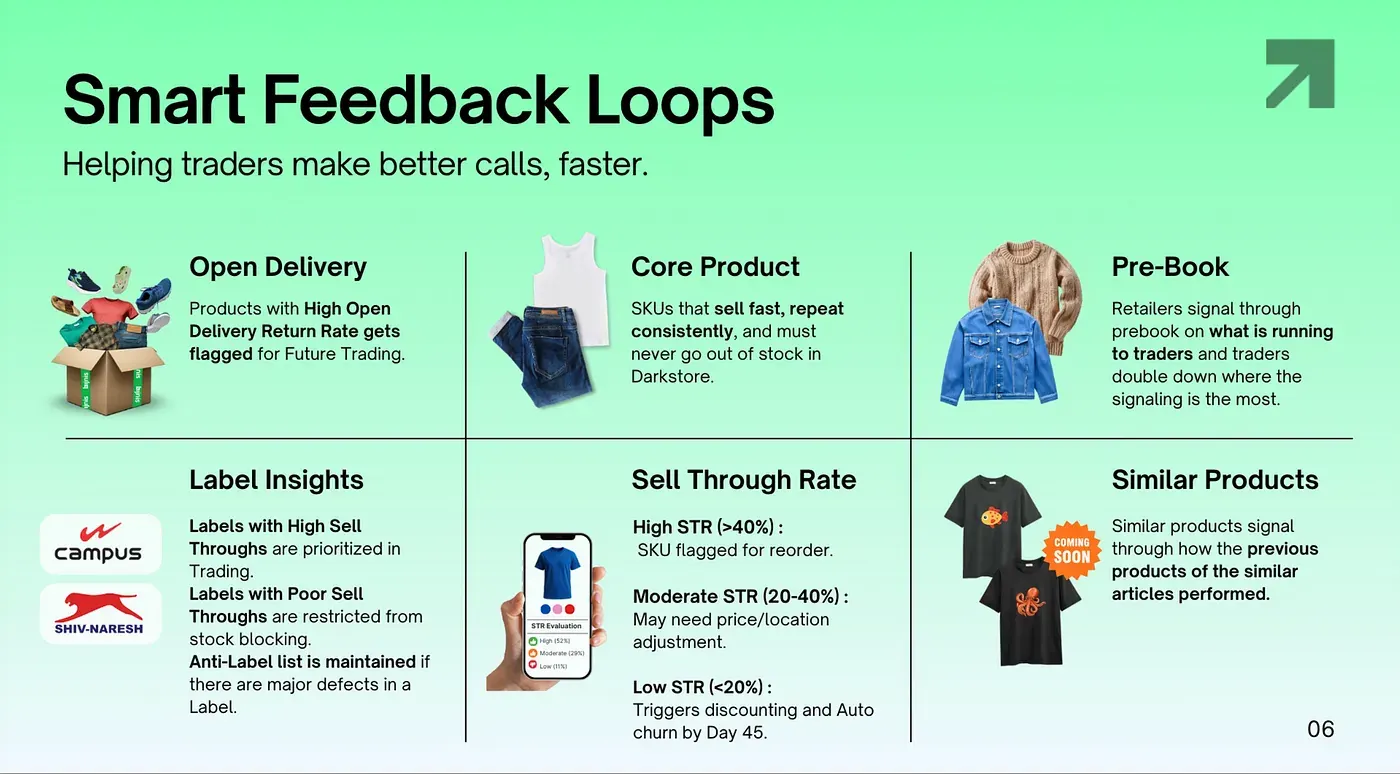
This 45-day auto-churn rule is what keeps liquidation below 2% and working capital structurally negative. The system doesn’t accumulate dead stock because it doesn’t allow dead stock to age. The moment an article proves it won’t sell at this price in this city, the decision to mark it down or move it out is automatic.
The feedback loop runs in parallel from the other direction too. Retailers signal what’s missing through pre-booking placing demand signals on articles before they arrive. When a trader sees strong pre-booking on a fresh article from an upcoming factory catalogue, it’s a forward demand indicator that upgrades the initial buy recommendation. The retailer who pre-books a product is telling the system she wants it; the system tells the trader to prioritize that article’s depth.
And when a high open delivery return rate comes in on a specific article when retailers are consistently inspecting and sending back a product, that article gets flagged immediately. High return rates are the system’s clearest signal of a quality or expectation mismatch. The article doesn’t get a second trading session until the issue is understood and resolved.
How do we measure Assortment Relevancy in a Darkstore?
At bijnis, we are obsessed with two numbers above all others: 10-day sell-through and 45-day sell-through for every SKU that enters a darkstore. These are our golden metrics. Every piece of stock that touches a bijnis shelf gets evaluated on two clocks and the system has zero tolerance for inventory that can’t keep pace with either.
The 10-Day Clock: Is This SKU Actually Moving?
Ten days is roughly the sell window that separates a relevant article from a shelf-warmer. If a SKU isn’t seeing meaningful movement within its first 10 days in the darkstore, the system treats that as a signal, not a coincidence. This is the early-warning layer of our assortment engine.
A 10-day sell-through rate below threshold doesn’t automatically trigger a churn decision — but it triggers a review. Is the SKU priced right for this city? Did it land in the wrong retailers’ hands? Is it a category that moves slower here? The system cross-references the article’s performance against similar SKUs in the same label, city, and price band. If the underperformance is isolated, we adjust. If it’s structural, the SKU goes on the 45-day watchlist with a lower reorder ceiling.
The goal of the 10-day check isn’t to punish slow movers it’s to catch mismatches early, before capital compounds on a wrong bet. In B2B quick commerce, where the promise to a Tier 2 retailer is that his stock will sell fast, a slow-moving SKU is a direct threat to that promise.
The 45-Day Clock: Full Verdict, No Extensions
Forty-five days is the outer limit of relevancy for a fashion article in a bijnis darkstore. If a SKU has not cleared at full price within 45 days, the system treats it as a failed placement — not a delayed success. There are no extensions, no “let’s give it another week,” no hoping that the season turns.
At the 45-day mark, the system automatically triggers a markdown and initiates churn. The discount is calculated to clear the remaining stock quickly without destroying margin perception in the market. The factory is notified. The trader’s performance record reflects the outcome. The article does not reappear in the next trading session without a specific review.
This 45-day hard stop is what keeps bijnis’s liquidation rate below 2%. The industry average for fashion liquidation is north of 15%. The difference isn’t luck — it’s the rule. By not letting dead stock age, the working capital stays structurally negative. The business doesn’t accumulate a legacy problem of stock that no one wanted.
The Composite Score: Three Numbers That Define a Darkstore’s Health
Beyond individual SKU tracking, bijnis measures each darkstore’s assortment relevancy through a composite view of three interlocking metrics:
Sell-Through Rate (STR) at 10 days and 45 days is the primary health indicator. A darkstore consistently hitting 60%+ STR at 10 days and 90%+ at 45 days is a darkstore where assortment decisions are working. Anything below 40% at 10 days is a signal that the trading session process needs recalibration either the trader is buying wrong, the factory mix is poor, or the city-level demand signal isn’t being read correctly.
Inventory Days tells us how fast capital is cycling. A darkstore running at 63 inventory days (where RTT 1.0 started) means capital is locked for over two months before it generates returns. Our goal is 12 inventory days meaning the same capital turns over 30 times a year instead of six. That isn’t just a financial efficiency metric; it’s a measure of how accurately we’re reading what Tier 2 retailers in each city actually need at any given moment in the season.
Fill Rate on Core SKUs is the third leg. Even if sell-through rates are excellent, a darkstore that keeps running out of its core SKUs the articles that retailers depend on, reorder repeatedly, and build their buying habits around is a darkstore that will eventually lose those retailers to the wholesale market. Fill rate on the core list must stay above 95%. Below that, the trust relationship with the retailer starts to crack.
These three metrics together define whether a bijnis darkstore is genuinely relevant to the retailers it serves — or just fast. Speed without relevancy is noise. Relevancy with speed is the entire business model.
The Numbers Behind the Engine: RTT in Evolution
The three metrics above are not static targets. They are a moving picture of how bijnis’s RTT system has evolved — and how far it still intends to go.
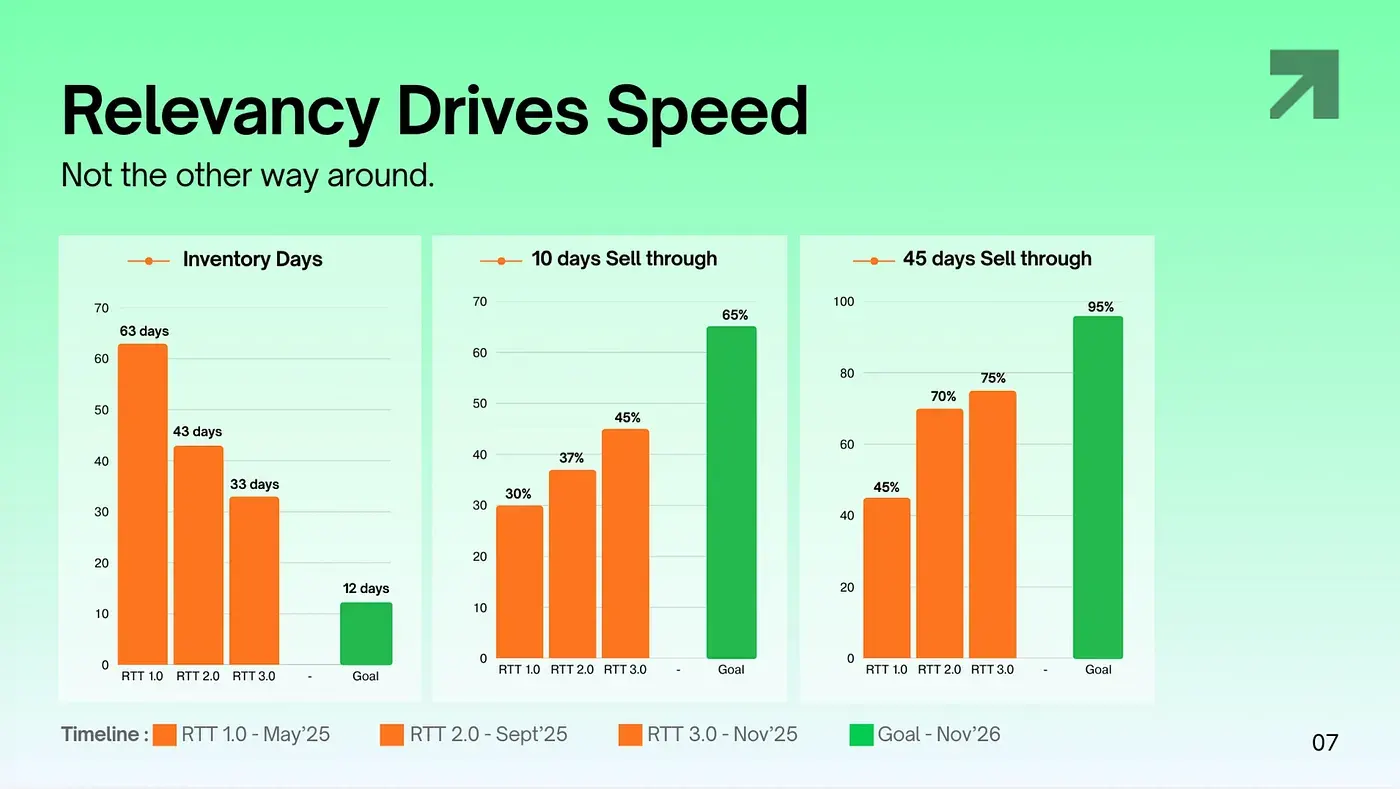
Sixty-minute delivery is the output. Assortment relevancy is the engine. For bijnis a company built to serve retailers across India’s fastest-moving B2B quick commerce categories, measuring that engine obsessively, at the SKU level, in every city, every session, is not a reporting exercise. It is the operating discipline that makes the headline promise real. A Tier 2 retailer in Surat or Ludhiana who orders through bijnis and finds the right stock, at the right price, reliably in stock that is what 60-minute B2B delivery actually means. Not the logistics. The assortment.
← All stories